
Applications · materials and devices
More samples measured cold, every week
Transport, superconductivity, quantum materials and device screening all need sub-kelvin data. The constraint is usually not the base temperature but how many samples you can get through.
Throughput is the experiment
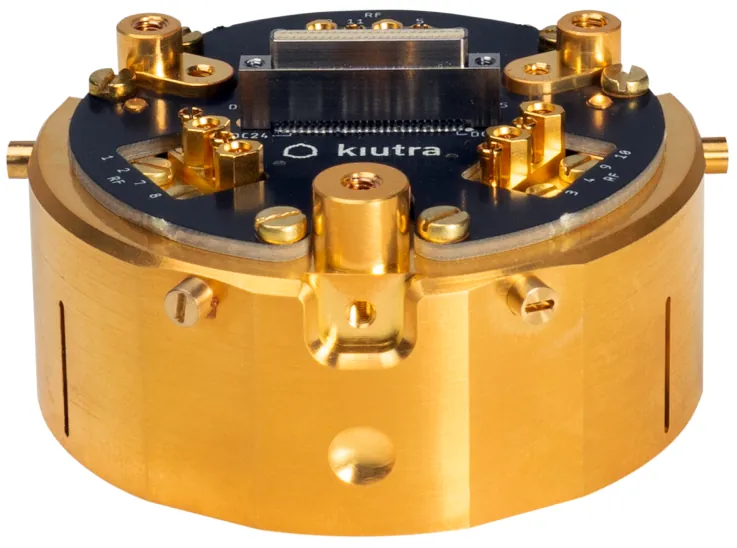
A conventional sub-kelvin system can take a day or more to cycle a sample. The Kiutra L-Type Rapid takes under 4 hours from loading to 50 mK, and 2 to 4.5 hours turnaround depending on configuration, with puck-based loading that does not require warming the cryostat. That turns a cryostat into a characterisation instrument: resistance and IV curves, superconducting resonators, RF transmission and thermometer calibration are the kinds of measurement Kiutra itself runs on this system.
Magnet options of 5 T or 8 T, or a 3–1–1 T vector magnet, cover field-dependent measurements, and magnetic shielding keeps the stray field at the sample below 50 µT when the magnets are on.
The numbers that matter here
Kiutra L-Type Rapid, as published by Kiutra.
50 mK – 300 K
Temperature range.
2 – 4.5 h
Sample turnaround.
55 × 117 mm
Puck 55 sample space, diameter × height.
Up to 8 T
Solenoid magnet option; 3–1–1 T vector option.
How many samples do you need to measure?
Tell us the measurement, the temperature and the field. We will propose an L-Type Rapid configuration.