
Custom Cryostat Configuration
Custom Cryostat Configuration: A Decision Guide for Quantum-Computing Research
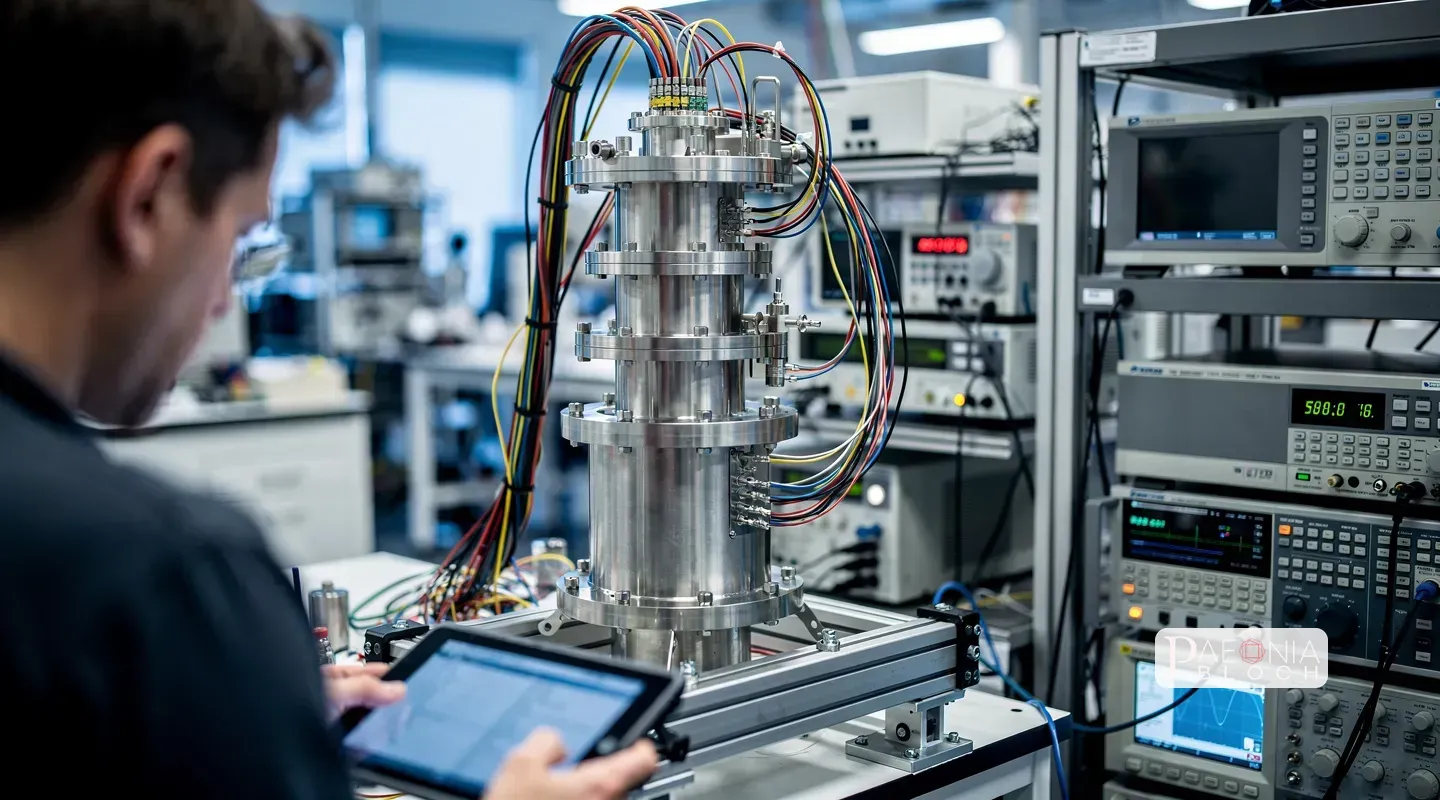
What should a configuration record capture?
Treat a Custom Cryostat Configuration as a requirement-and-status record for one experiment. Its purpose is to show which fields are settled, preferred, or open before a quotation.
For each field, record the requirement, its review owner, its status—required, preferred, or open—and the check needed before purchase. This gives the research group and manufacturer a shared list without treating a product name as a complete specification.
Use these entries:
- Experiment: sample or device, application, and operating cycle.
- Cooling: target range, ADR-based helium-3-free cooling or dilution refrigeration, and whether one-shot hold time or continuous cooling matters.
- Measurements: resistance, IV curves, superconducting resonators, RF transmission, or thermometer calibration, plus sensor, heater, and sample-signal leads.
- Wiring and mechanics: line count, heat load, connectors, space, magnetic environment, and mechanical access. Every signal line entering a cryostat creates a path for heat, while wire selection balances thermal conductivity, electrical resistance, current capacity, flexibility, and magnetic compatibility.
- Support: installation support, training services, documentation, and local support questions for the quotation discussion.
Sub-kelvin cooling means cooling below 1 K. It is used in quantum computing and other low-temperature research. Kiutra cryostats use ADR technology and closed-cycle cryocoolers with a base temperature below 4 K. A one-shot ADR provides a limited hold time, while dilution refrigeration provides continuous cooling and relatively large cooling power. Record these as configuration conditions, not as a conclusion about suitability.
If Cri/oFlex® wiring is under consideration, include its intended use, line count, cryostat compatibility, and connector requirements in the record. Cri/oFlex® is flexible cryogenic cabling for qubit control, readout, and other low-temperature experiments.
Our process covers describing the experiment, configuring and quoting the system, delivering and installing it, and providing support after handover.
We distribute Kiutra cryostats in the ASEAN region.
Record the experiment and its operating constraints
Your experiment description should identify the device or sample, the measurement sequence, and the conditions that must remain stable during each run. The experiment is the anchor for every later configuration choice.
Write down:
- The research area, such as superconducting qubits, spin qubits, optical work, detector measurements, or materials characterization.
- The sample or device format, including its approximate dimensions, mounting approach, and any access needed during installation or measurement.
- The target temperature range and whether the work needs a brief measurement window or repeated operation over a longer session.
- The measurements you will make, including DC, RF, transport, resonator, optical, or thermometer work where applicable.
- The number and type of sensors, heaters, control leads, and sample-signal lines.
- Any restrictions on magnetic fields, electromagnetic noise, connector placement, vibration, or room-temperature instrument layout.
- The available laboratory space, utilities, lifting route, and installation conditions.
Cryostat requirements commonly include materials, heat transfer, thermal insulation, structural supports, safety, instrumentation, seals, connections, and transfer lines. Your first record does not need to provide a final engineering design. It needs to identify which of those areas could affect the research setup so they can be discussed before a quotation.
Use the record to show how each constraint affects a later decision. For example, connect the required measurement to its temperature range, then connect that range to the required cooling mode and operating pattern. Connect each measurement type to its sensor, heater, control, or sample-signal leads. This makes it easier to see whether a missing value belongs to the experiment description, the cooling review, or the wiring review.
When a value is not known, mark it as open rather than filling the gap with a product assumption. You can record a preferred connector, line count, or access arrangement while keeping the final detail open for manufacturer confirmation. If two requirements may compete, keep both visible and write the question they create. A high line count, for instance, should remain linked to the heat-load and connector discussion rather than appearing only as an electrical total.
Keep required conditions, preferences, and open questions in separate fields. A required temperature range describes what the experiment needs; a preferred product or cable format describes how the team would like to meet it; an open question identifies what the quotation or configuration review must resolve. Add the person or group expected to answer each open question, so the record shows not only what is unknown but also where confirmation belongs.
At review time, read the entries in the same order as the experiment: measurement, cooling, wiring, mechanical access, and support. This order helps the research group explain why a configuration detail matters instead of presenting disconnected specifications. It also gives the manufacturer a clear route from the research requirement to the proposed cryostat, wiring, installation, and training discussion.
Your priority order should separate conditions that are essential from conditions that are negotiable. For example, a minimum temperature may be required for a measurement, while a particular connector arrangement may be a preference that can change after the wiring review.
Use a short priority record:
- Required research condition: describe the measurement or device condition that cannot be removed.
- Required operating condition: record the temperature range, cooling mode, and run pattern that the experiment needs.
- Required interface condition: state the line count, signal types, sample access, and connector constraints.
- Preferred configuration detail: list choices that would make operation easier but are open to discussion.
- Open confirmation: mark every item that needs manufacturer or configuration-specific confirmation.
Use the record to separate fixed requirements from preferences.
Plan the cryogenic wiring before purchase, and define sensor, heater, and sample-signal leads separately.
What should a configuration verification record capture?
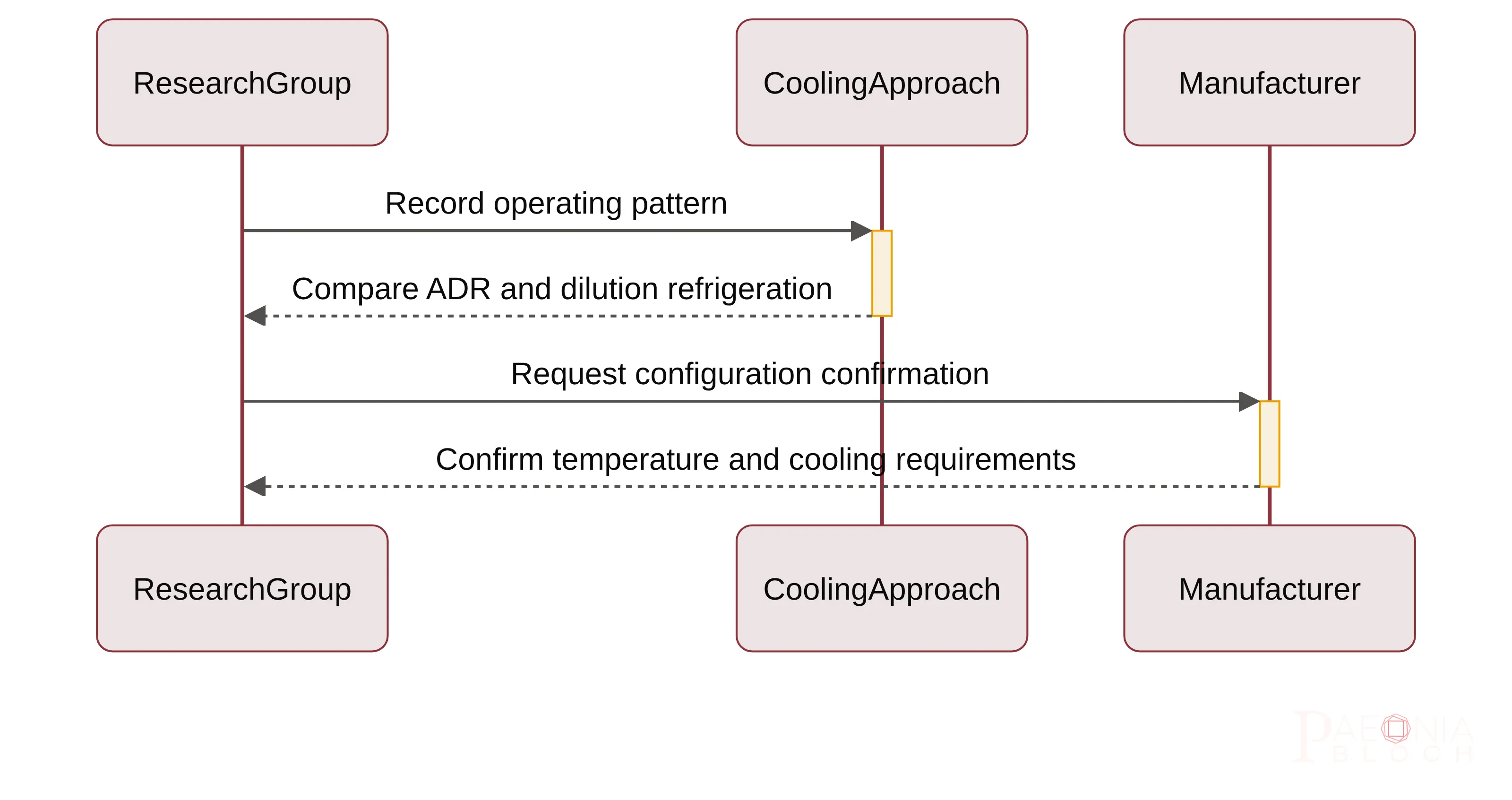
Use a configuration verification record to capture the fields that must be stated or confirmed before a custom cryostat discussion. Start with the experiment, then record the operating pattern, cooling approach, measurement needs, wiring, and open confirmation points.
Keep the record field-based:
- Experiment: Note whether the work concerns superconducting qubits, spin qubits, optical systems, materials characterization, or another low-temperature application.
- Operating pattern: State whether the measurement needs continuous cooling or a defined hold time.
- Cooling: Name ADR-based helium-3-free cooling, dilution refrigeration, or both for comparison.
- Measurements: List the measurement types, sequence, and duration.
- Wiring: Record sensor, heater, and sample-signal leads, estimated line count, connectors, and heat considerations.
- Confirmation: List the selected system’s stages, temperature, cooling capacity, operating mode, and interfaces as items to verify.
For a one-shot ADR, include the required hold time: the cooling medium provides cooling for a limited period, that period varies with temperature, and it ends when the medium is fully demagnetized. If the work needs continuous cooling, record that requirement separately rather than inferring suitability from a product name.
A cooling comparison should use the same criteria for both approaches:
| Criterion | ADR-based helium-3-free approach | Dilution refrigeration |
|---|---|---|
| Cooling pattern | A one-shot ADR provides a limited hold time; other ADR configurations require their own confirmation. | The cited review describes dilution refrigeration as continuous cooling. |
| Main question for your brief | Is the available operating window suitable for the measurement sequence? | Does the experiment require continuous operation and relatively large cooling power? |
| Research context described in our material | We associate ADR systems with sample characterization, detectors, optics, and materials research. | We associate dilution refrigerators with large qubit processors. |
| Configuration boundary | Confirm the selected system’s stages, temperature, cooling capacity, and operating mode. | Confirm the selected refrigerator’s temperature, cooling power, line capacity, and interfaces. |
The table gives you a way to organize a discussion; it does not establish that either approach is suitable for your experiment. Record the operating pattern and ask for configuration-specific confirmation before purchase.
Bring the completed configuration verification record to the next discussion with its open fields visible. Ask for configuration-specific confirmation of the cooling mode, temperature, stages, cooling capacity, wiring compatibility, connectors, and line count before purchase. Keep installation support, training services, and local support as separate questions rather than assumptions.
When might ADR-based helium-3-free cooling fit the brief?
An ADR-based helium-3-free cryostat may fit a brief when helium-3 is not available or when single-shot operation is sufficient. We also describe ADR systems in contexts such as sample characterization, detectors, optics, and materials research. Treat those points as starting conditions for a technical discussion, not as a suitability decision for your setup.
Kiutra cryostats use ADR technology for sub-kelvin cooling and closed-cycle cryocoolers with a base temperature below 4 K. The selected product information separately states that Kiutra systems can use up to four ADR stages, provide single-shot cooling below 100 mK, and provide continuous cryogen-free cooling down to 300 mK. These figures describe different parts or operating modes of the product information, so your brief should identify which mode and temperature range your experiment requires.
A one-shot ADR has a limited hold time. The hold time depends on the cooling medium’s capacity, varies with operating temperature, and ends when the cooling medium is fully demagnetized. Record the expected measurement window and the number of repeated runs before treating a one-shot configuration as a possible fit.
Your ADR screening record should contain:
- The lowest temperature your measurement requires.
- Whether the experiment needs single-shot or continuous cooling.
- The expected duration of each measurement and the number of runs in a session.
- The number of sensors, heaters, control lines, and sample lines.
- Any optical, detector, sample-screening, or materials-characterization access requirements.
- The questions that must be answered for the selected Kiutra configuration.
We distribute Kiutra cryostats in the ASEAN region and can scope the configuration with your research group and the manufacturer before providing a quotation. That process is the supported next step when the ADR path remains open after you have recorded these conditions.
When should dilution refrigeration be investigated?
Dilution refrigeration should be investigated when your requirements point to continuous cooling, relatively large cooling power, or a large qubit-processor workload. A review describes conventional dilution refrigeration as a continuous-cooling method with relatively large cooling power and temperatures reaching several millikelvin. We typically associate dilution refrigerators with large qubit processors, while we associate ADR systems with sample characterization, detectors, optics, and materials research.
Use the recorded requirements to compare cooling approaches. Record the required temperature, cooling power, measurement duration, sample or processor format, signal-line count, and access requirements. A broad label such as quantum computing does not replace those details because superconducting-qubit experiments can have different wiring, control, readout, and cooling requirements.
The cited review reports a lowest temperature of 1.75 mK and cooling power of 2 mW at 100 mK for conventional dilution refrigeration. Those are reported review values, not a promise for a particular system or configuration. Ask for the specifications that apply to the refrigerator being considered, including the conditions attached to temperature and cooling-power figures.
Build the wiring requirement as its own record
Your wiring requirement should be a separate record attached to the cryostat brief. Cryogenic wiring should be planned before purchase, with sensor, heater, and sample-signal leads defined separately. We plan the cryostat and its internal wiring together to address line count, heat load, and connector requirements.
Start with the measurement path, then translate it into leads and interfaces:
- Sensors: list each temperature or field sensor, its location, and the measurement method.
- Heaters: state the number of heater leads and the current requirements that must be checked.
- Sample signals: separate DC, low-current, transport, RF, resonator, optical-control, and other signal types where they follow different paths.
- Control lines: include lines used for magnets, actuators, switches, or other cryostat functions.
- Spare lines: state whether spares are required and why; unused wiring can add heat load and complexity.
- Room-temperature interfaces: record feedthroughs, connectors, shielding, grounding, and the pinout documentation needed by your team.
Sensor count is not the same as lead count. A precision RTD measurement, for example, may require four-wire wiring, so count conductors rather than only devices.
Your wire specification should state the trade-offs that matter to the experiment. Cryogenic wire selection balances thermal conductivity, electrical resistance, current capacity, flexibility, and magnetic compatibility. Thermal anchoring reduces heat leak from room temperature to the cold stage, while every signal line entering a cryostat creates a path for heat.
Do not describe a line only as a channel. State its function, expected signal, current, frequency, temperature-stage route, connector, and shielding or grounding requirement where applicable. That record lets the cryostat and wiring be considered together instead of forcing the wiring plan into an already fixed mechanical arrangement.
Your wiring record should be ready before the quotation discussion. We specify wiring for each cryostat and experiment and confirm compatibility with both manufacturers before quoting. We also involve Delft Circuits at the design stage when preparing quotations for custom wiring.
Use the record to ask which line types, connector arrangements, and cabling assemblies are included, which remain open, and which details need a drawing or pinout review. Ask for the same clarity on any datasheet you receive.
Treat signal-line count as a thermal and mechanical input
Your signal-line count affects more than the number of electrical channels. Every signal line entering a cryostat creates a path for heat, and the wiring plan must balance thermal conductivity, electrical resistance, current capacity, flexibility, and magnetic compatibility. Line count therefore belongs in the early mechanical and thermal discussion.
Count each category separately:
- Sensor conductors, including the lead count needed by each sensor type.
- Heater conductors, with the current capacity that must be checked.
- Sample and device signals, separated by DC, RF, resonator, transport, or other measurement function.
- Control and switching lines.
- Ground, shield, and reference conductors where they form part of the interface.
- Spare lines, identified as a deliberate choice rather than an unexamined addition.
A payload module in the stated X-Type configuration carries 768 lines, while the stated recombined system covers payload modules of 768 and 3,072 RF lines. Those figures belong to the stated X-Type configurations and should not be treated as a general capacity for every cryostat.
The thermal record links line count with stage routing and anchoring. State where each line enters, where it is thermally anchored, which cold stage it reaches, and what connector or feedthrough it uses. The wiring source identifies thermal anchoring as a way to reduce heat leak from room temperature to the cold stage.
Bring a preliminary line schedule even when the final pinout is open; the schedule identifies the decisions that require confirmation before quoting.
Your next action is to attach a line schedule to the configuration brief and mark every uncertain count or connector. We specify wiring per cryostat and experiment and confirm compatibility with both manufacturers before quoting, so an explicit schedule gives the discussion a concrete input.
Check whether Cri/oFlex® wiring belongs in the configuration
Cri/oFlex® wiring may belong in your configuration when your experiment needs flexible cryogenic cabling for qubit control, readout, or another low-temperature experiment. Cri/oFlex® has eight channels on a 0.3 mm flex. The useful question is not whether the name appears in a brief; it is whether the cable format, channel count, interface, and cryostat routing match the measurement plan.
Record these details before asking for a cabling match:
- The number of signal paths and the function of each path.
- The required frequency, current, shielding, grounding, and connector arrangement.
- The cryostat model or configuration under consideration.
- The cold-stage route, available space, and any bend or access constraints.
- Whether the cable serves qubit control, readout, sample signals, or another low-temperature measurement.
- Whether the eight-channel, 0.3 mm flex format is relevant to your specific interface.
A cable description alone does not establish compatibility. The cryostat, experiment, line count, connectors, and manufacturer confirmation must be considered together.
Matching Delft Circuits systems are quoted based on the cryostat model and required line count.
Send the cable question with the cryostat model, line schedule, connector information, and measurement functions. Ask which details are confirmed, which are proposed, and which require a drawing or manufacturer review. Use that boundary instead of assuming that a named cable is compatible with an unconfirmed cryostat.
Your custom-wiring discussion can include Delft Circuits at the design stage. We involve Delft Circuits when preparing quotations for custom wiring, so include the cable and interface requirements in the same record as the cryostat request.
Match the brief to the research application
Your research application should determine which configuration questions receive priority. Superconducting qubits, spin qubits, optical systems, detector work, and materials characterization can place different demands on temperature, wiring, access, and measurement interfaces.
For superconducting-qubit work, record the control and readout line count, RF requirements, device mounting, sample access, and the operating pattern. We offer X-Type base configurations for superconducting qubits and spin qubits, each with specified cooling power and temperature characteristics. The selected base configuration still needs to be matched to your actual line count and experiment.
For spin-qubit work, separate the device signals from control, sensor, and field-related lines. State the magnetic and connector conditions that need confirmation, rather than treating the application label as a complete specification.
For optical systems and detectors, record the optical path, access arrangement, detector interface, and measurement sequence. We describe ADR systems in contexts including optics and detectors, but the relevant temperature, hold-time, access, and wiring requirements remain configuration-specific.
For materials and device characterization, list the measurements rather than using only the application name. The Kiutra L-Type Rapid can perform resistance and IV-curve measurements, superconducting-resonator measurements, RF transmission measurements, and thermometer calibration. Those stated measurement types can help you frame a discussion; they do not confirm suitability for a particular sample or setup.
Your module record should state whether line growth is expected during the project. The X-Type cooling system allows additional cooling modules to be added to increase cooling capacity, according to the stated product information. The same product information states that a payload module carries 768 lines and that a recombined system can deliver 100 µW at 20 mK across payload modules of 768 and 3,072 RF lines. Treat those as specifications of the stated X-Type configurations, with the applicable configuration and conditions to be confirmed.
Ask which module, line, temperature, and cooling-capacity details apply to your requested configuration. Record the answer beside the application requirements so future changes to the experiment can be compared against the same configuration record.
Separate stated Kiutra options from details to verify
Your Kiutra configuration record should separate stated product information from details that apply only after your requirements are reviewed. The selected product information states that Kiutra cryostats use ADR technology, closed-cycle cryocoolers with a base temperature below 4 K, up to four ADR stages, single-shot cooling below 100 mK, and continuous cryogen-free cooling down to 300 mK.
The stated X-Type information describes two base configurations for superconducting qubits and spin qubits, additional cooling modules, a payload module carrying 768 lines, and a recombined system covering payload modules of 768 and 3,072 RF lines. It also states 100 µW at 20 mK across those payload modules. These figures belong to the stated configurations and should remain attached to the relevant product and operating conditions.
The stated L-Type Rapid application information covers resistance and IV-curve measurements, superconducting-resonator measurements, RF transmission measurements, and thermometer calibration. Use those measurement categories to describe your work, then ask which configuration details apply to your sample, wiring, and temperature range.
Your verification column should contain questions such as:
- Which Kiutra model and base configuration address the stated application?
- Which temperature figure applies to the required operating mode?
- Is the stated value a base temperature, a single-shot temperature, or a continuous-cooling figure?
- Which cooling stages and modules are included in the proposed configuration?
- What cooling capacity applies at the temperature and line count your experiment requires?
- Which payload and RF-line figures apply to the proposed arrangement?
- Which sample space, connectors, access paths, and wiring interfaces are included?
- Which details depend on a manufacturer review or a final mechanical drawing?
We offer X-Type base configurations for superconducting qubits and spin qubits, with specified cooling power and temperature characteristics. Keep those two discussions connected while each product detail is checked against your experiment.
Your configuration record is ready for quotation only when every material unknown has an owner and a next question. Use that stage to resolve temperature mode, cooling capacity, line count, wiring, access, and interface details rather than turning an unverified product figure into a purchase assumption.
Create a configuration verification record
Your configuration verification record should connect each research requirement to a proposed configuration detail and a confirmation question. Cryostat design should begin by explicitly determining and prioritizing requirements, and our process scopes the configuration with your research group and the manufacturer before providing a quotation.
Use one row or entry for each material requirement:
- Research requirement: state the measurement, sample condition, or operating need.
- Requested value or range: record temperature, duration, line count, current, frequency, access, or other measurable condition where applicable.
- Proposed configuration detail: identify the product, stage, module, cable, connector, or interface being considered.
- Source of the detail: record whether it comes from a product description, a wiring discussion, or the configuration review.
- Open condition: state the temperature mode, cooling stage, line route, mechanical condition, or other point that still needs confirmation.
- Responsible confirmation: identify whether the research group, manufacturer, or installation discussion must resolve it.
- Decision status: mark the item as open, proposed, confirmed for quotation, or changed after review.
The record prevents a general product description from being mistaken for a confirmed configuration. It also gives your team a common document for technical, purchasing, installation, and training questions.
Your verification record should include a wiring review before purchase. Cryogenic wiring guidance recommends defining sensor, heater, and sample-signal leads separately, checking line count, considering thermal anchoring, and defining feedthroughs, connector layouts, shielding, grounding, and pinout drawings.
We involve Delft Circuits at the design stage when preparing quotations for custom wiring. Add the following checks to the record:
- Sensor continuity and lead count.
- Heater lead count and current capacity.
- Sample-signal and RF paths.
- Cryostat model, connector arrangement, and line route.
- Thermal anchoring and heat-load questions.
- Pinout, shielding, grounding, and documentation.
- Compatibility confirmation for the cryostat and cabling manufacturers.
These checks describe the information to organize; they do not confirm a result for an unreviewed configuration.
Your acceptance record should state which wiring and interface checks will be made during factory and site testing. The wiring guidance identifies continuity, pinout, sensor, heater, sample-signal, and documentation checks as items for FAT and SAT. Include only the checks that apply to your configuration, and assign each one to a person or stage of the project.
Prepare the quotation request with project details
Your quotation request should carry enough project detail to start a configuration discussion. Include the experiment summary, temperature range, cooling approach under consideration, measurement list, line schedule, cryostat or product preference, installation conditions, and the questions that remain open.
Attach these items:
- A short description of the sample, device, or processor.
- The required temperature range and operating mode.
- The expected measurement duration and repeated-run pattern.
- Sensor, heater, control, sample, and RF line counts.
- Connector, feedthrough, shielding, grounding, and pinout requirements.
- Sample-space, optical-access, detector, or mechanical-access needs.
- Any preferred Kiutra model or configuration, marked as a preference rather than a final selection.
- Whether Cri/oFlex® wiring may be relevant to the line and interface plan.
- Installation location, laboratory constraints, and the support questions your team needs answered.
We also plan the cryostat and wiring together to address line count, heat load, and connector requirements.
Before you send the request, check that every major statement has the right status. Mark a temperature or measurement condition as required when the experiment depends on it. Mark a model, cable format, connector, or access preference as preferred when the team can discuss another arrangement. Mark a cooling figure, line capacity, interface, or operating mode as open when it still requires configuration-specific confirmation. This distinction keeps a product description from becoming an unreviewed purchase assumption.
Then compare the experiment summary with the line schedule. Each stated measurement should have a corresponding signal, sensor, heater, control, or access entry, or an explanation of why it does not require one. Each line category should have a function and an interface question. If the counts do not match, leave the difference visible in the request rather than silently changing the experiment description or adding unexplained spare lines.
Use the cooling section to state the operating pattern in practical terms: whether the work is intended for continuous cooling or a defined single-shot window, how long a measurement session is expected to run, and which temperature range must be reviewed. Do not turn those entries into a suitability conclusion. They are the conditions against which the proposed ADR-based helium-3-free or dilution-refrigeration configuration can be discussed.
Finish with a confirmation list. Ask which details are included in the proposed configuration, which depend on a manufacturer review, which wiring and connector drawings are needed, and which installation, training services, warranty, and service points belong in the quotation. Include the project timing category separately from delivery expectations. A request organized this way gives the research group one document to revise when a requirement changes and gives the configuration discussion a clear record of what remains unresolved.
Your project timeline should describe when the system is needed, without turning a request date into a delivery promise. When requesting a quotation, you can indicate whether you need the system now, this quarter, within 12 months, or later. Choose the option that matches your research planning and add any internal decision date or grant milestone separately.
A timing category helps frame the discussion, but it does not establish delivery timing. Keep configuration questions, quotation timing, procurement approval, and installation planning as separate items in your project record.
Your quotation review should include warranty and service terms. Warranty and service terms follow the manufacturer’s conditions and are detailed in each quotation. Record those terms alongside the proposed configuration, installation scope, support after handover, and any training services you need to discuss.
Your ASEAN project can include regional support questions in the same request. We distribute Kiutra cryostats in the ASEAN region, and we specify wiring for each cryostat and experiment before quoting. State your location, installation conditions, and local support requirements so those points remain part of the configuration discussion.
Confirm installation, training, and local support
Your support plan should cover installation, handover, training services, documentation, and follow-up questions. We describe a process that covers your experiment, system configuration and quotation, delivery and installation, and support after handover.
Ask for the support boundaries in writing:
- What does delivery include, and what must your laboratory prepare before installation?
- Which installation tasks are included for the cryostat, wiring, connectors, and room-temperature interfaces?
- What handover documentation will your team receive?
- What training services should be planned for operators, measurement users, and maintenance contacts?
- Which checks are completed during installation and handover?
- How are post-handover questions and service requests handled?
- Which warranty and service conditions apply under the manufacturer’s terms?
These questions define the support record. They do not establish that a particular task, training session, or service term is included until it appears in the applicable quotation or support discussion.
Your ASEAN support record should state the installation country, site conditions, local contacts, access restrictions, and the type of local support you need. We distribute Kiutra cryostats in the ASEAN region and provide support after handover as part of the process we describe. The exact service scope remains tied to the configuration and manufacturer’s conditions.
Record practical site details such as the room, delivery route, available utilities, lifting or access constraints, instrument locations, and the people who will attend handover. Keep those details with the installation questions rather than leaving them to a late-stage logistics conversation.
Your installation checklist should include the wiring interface and its documentation. Cryogenic wiring guidance identifies continuity, pinout, sensor, heater, sample-signal, and documentation checks for FAT and SAT. We involve Delft Circuits at the design stage when preparing quotations for custom wiring, so include the final cable and connector questions in the installation record.
Use the handover discussion to identify which wiring checks have been completed, which records have been supplied, and which operating questions still belong with your research team or the manufacturer.
Your next action is to add installation, training services, and local support questions to the same verification record as the cooling and wiring requirements. We deliver and install the system and provide support after handover within the process we describe, while the quotation sets the applicable service and warranty conditions.
Bring your configuration brief to the next discussion
Your configuration brief is ready when it connects the experiment, cooling approach, measurement plan, signal-line record, application, verification questions, quotation details, and support needs. A prioritized requirements list gives you a sound basis for comparing ADR-based helium-3-free cooling with dilution refrigeration, and a separate wiring record keeps line count, heat load, connectors, and compatibility visible.
We distribute Kiutra cryostats in the ASEAN region, plan the cryostat and wiring together, specify wiring for each cryostat and experiment, and scope the configuration with your research group and the manufacturer before providing a quotation. Bring your experiment summary, operating constraints, line schedule, open questions, installation requirements, training services questions, and local support needs to that discussion. A qualified professional should decide individual engineering suitability for your setup.
Your next step is to turn the brief into a configuration discussion or quotation request, with your required values separated from preferences and open confirmations. Include the timeframe category that matches your project: now, this quarter, within 12 months, or later.
What must be confirmed before you rely on the brief?
What information should I include in my cryostat configuration brief?
Your configuration brief should include details about the experiment, such as the sample or device, temperature range, cooling mode, measurement requirements, and any installation or training support needed.
How do I determine whether to use an ADR-based helium-3-free cryostat or a dilution refrigerator?
Consider using an ADR if your experiment requires single-shot operation and helium-3 is unavailable.
What should I confirm before requesting a quotation for a cryostat?
Before requesting a quotation, confirm the specific temperature requirements, cooling capacity, line count, wiring compatibility, and any installation or training support needed.
How can I ensure that Cri/oFlex® wiring is suitable for my cryostat configuration?
To ensure Cri/oFlex® wiring is suitable, verify that the cable format, channel count, and routing match your measurement plan and confirm compatibility with the cryostat model.
Next step
Have a question for Paeonia Bloch?
Kiutra cryostats and Delft Circuits cryogenic wiring
Get in touch